David Cox was born April 23, 1841, in Dundee, Angus, Scotland; the son of David Tullo Cox (1810 – 1847) and Christina Young (1818 – 1905).
David Tullo Cox was a brother in the famous Cox family of Dundee. The Cox brothers owned and operated one of the largest jute manufacturing businesses in the world. However, David Tullo Cox chose to be a seaman and was a mate or Master of sailing ships. His was a difficult life and he barely survived one incident in which his ship capsized and he and several of the crew were not rescued until near starvation. David lost several toes and part of a foot which were later replaced with cork at St. Petersburg, Russia. It was during his recovery and treatment at Bristol that he apparently spent time in Dundee and fathered David Cox. Christina Young was a jute weaver and would have been working at Camperdown, where the Cox Brothers facility was located. David Tullo Cox probably was working there temporarily while recovering and met Christina. David Tullo returned to sea before his son David was born and never returned to acknowledge his son’s birth, later dying of fever aboard ship in the Gulf of Mexico in February 1847. Christina documented the situation at the Lochee kirk session and named her son after his father but never baptized him although she would have been permitted to do so. David was Christina’s only child.
David lived with his mother Christina and her family until he was in his teens and then with his mother until he was 21. Christina’s father James was a mason and David no doubt learned the trade from James. By the age of 20 he was working as a mason. He stayed in the mason and building trade his entire working life.
In September 1862, David left from Forfarshire, Scotland for New Zealand on the ship Mermaid to join his uncle William Stewart Young who had emigrated there shortly before. The cost of his passage was shared by his family and the provincial government. He arrived in Lyttleton, New Zealand, about December 26, 1862. No records have been found that we can be certain address David’s time in New Zealand.
In 1871, David came to the United States. It is not known whether David went home to visit Christina before coming to the United States. It appears all incoming passenger lists to Great Britain pre‑1878 were destroyed in error by the British Board of Trade in 1900. Wherever he arrived, he eventually settled in St. Louis, Missouri. He was naturalized there on October 20, 1876. That record shows only that he was a native of Great Britain and still a subject of the Queen. In St. Louis, David worked in various forms of construction and home remodeling and repair. A small journal of his expenses and billings survives. From the journal, it can be seen that David was doing stone and masonry work in St. Louis and suburbs.
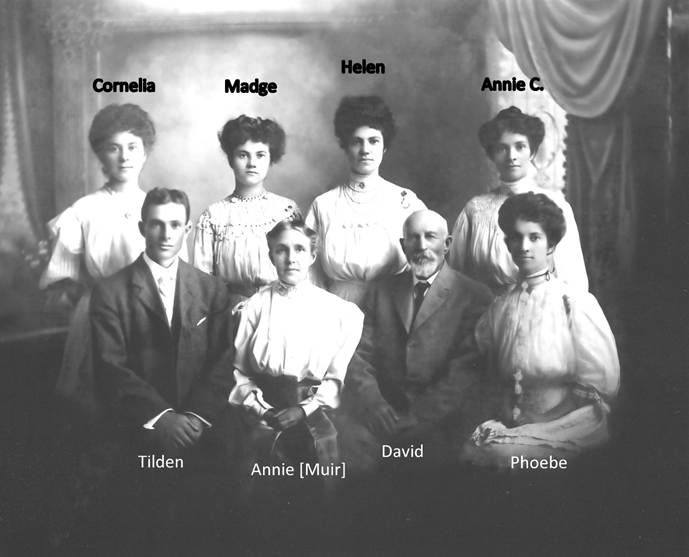
David married Annie Muir July 3, 1873, in St. Louis. Annie was the daughter of William Muir and Helen Bald. She was born January 23, 1851, at Bow Street (the site of her father’s bookstore), in Stirling, Scotland, and died January 7, 1941, in Denver, Denver, Colorado. The family lived in Webster Grove and St. Louis, before moving to Denver about 1891 when the Denver city Directory shows David as a stone contractor, located at 7th street on the southeast corner of Wewatta, and boarding at the Colorado House. His family followed him to Denver shortly afterwards.
The 1892 Denver City Directory shows David, stone contractor, with his family residing at 2018 14th in the Highlands area of Northwest Denver. David's son, Tilden, is working with his father and residing at 1820 14th Street in Highlands.
A short report in the Rocky Mountain News on 31 Jul 1892 states that “David Cox is putting up a stone residence on Homer Avenue [now Lowell Blvd]”.
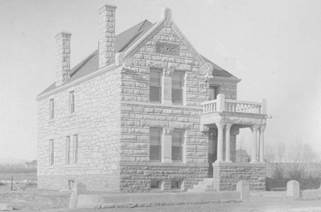
This is where David built the “House of the Gargoyles” now numbered as 3425 Lowell Boulevard for his family home. It is a masterwork in stone with interesting stone carvings found on the eaves, the tops of chimneys, and in the spaces between windows. Gargoyle heads are located at the ends of the gutters [See details picture.] The Gargoyle House was designated a City and County of Denver Landmark in 1973.
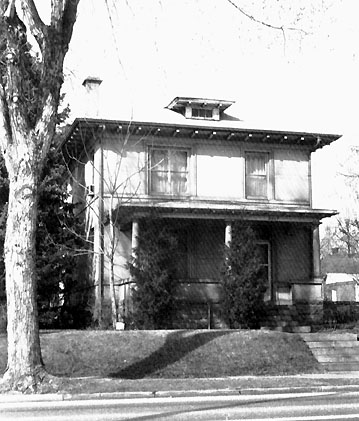
About 1898, he built a second family home [below left] next door at what was then 3381 Homer Boulevard. The family moved into that house and rented the Gargoyle House. The house at 3381 is not as intriguing, being square cut stone. However, the outside walls are eighteen‑inch‑thick slabs of pink (now turned gray) sandstone from Creede, Colorado, laid upright, a rare method of construction which required cranes to lift the stone blocks.
In 1900, the family was still living at 3381 Homer Boulevard in Denver and was still renting the Gargoyle House. This address was later changed to 3417 Lowell Blvd. At that time, David owned and operated David Cox & Son, with his son Tilden, located at 1st and Walnut.
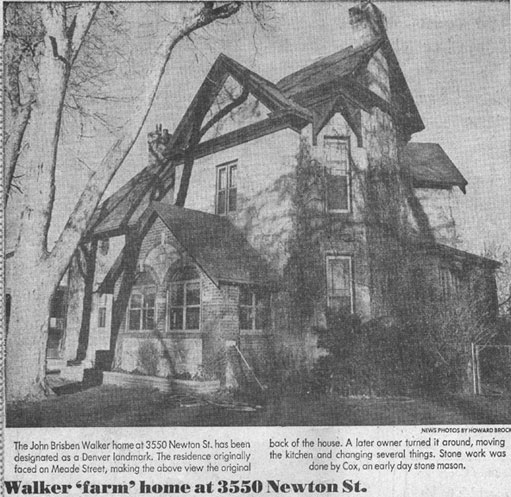
David and his son worked on many homes and buildings in the Denver area. They are believed to have worked on the Wyoming State Capital building also. However, specific records have been difficult to locate. One home of note that David is reported to have contributed to was that of John Brisben Walker. This home was located in Northwest Denver near David's own home. Picture of the Walker house. These homes have been written about extensively and both of David’s personal homes have been restored by later owners.
For many years, David was on the Board of Directors of the Denver Master Builders’ Association. David Cox & Son’s work was mentioned many times in local news articles. These are some examples:
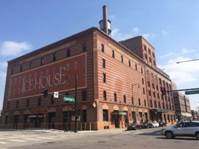
| 1903: Cox & Son was the stone contractor for the Littleton Creamery refrigeration warehouse at 18th & Wynkoop (later the Beatrice Foods Icehouse) and the Marble Hall at 1820 Cleveland Place. A prominent industrial work of Gove & Walsh architects, 1801 Wynkoop is a wonder of bricklaying craftsmanship. The building was constructed in several phases, beginning in 1903, as a refrigeration warehouse first for Littleton Creamery, then the Beatrice Creamery. |
|
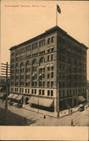
| 1905: David Cox & Son did the excavation and foundation work of the Commonwealth Building at the corner of Stout and 15th St. |
|
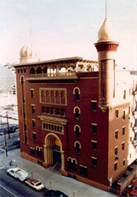
| 1906: Cox & Son did the stone work for the Mosque of the El Jebel Shrine Temple at 1770 Sherman St. The shrine was added to the National Historic Register in 1997. |
|
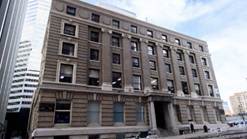
| 1907: The entrance to the Y.M.C.A. building on 16th Ave. was one of the most imposing and artistic of its kind in Denver. Two columns of Colorado granite adorned each side of the doorway and a lintel was set on top. The columns were 14 ft high, 2 ft in diameter and weighed 4 tons each. The lintel was 14 ft long. David Cox & Son did the cutting and erecting of the entrance pieces. |
|
| 1908: David Cox & Son did the work to put into shape the famous Colorado grindstones made by C.E. Treadwell. The stones were cut from the west bank of the Gunnison River. | Colorado Grindstones |
After a long and very successful career, David Cox died February 15, 1915 in Denver. He is buried at Crown Hill cemetery in Wheat Ridge, Colorado, with Annie. Several of the family are buried at Crown Hill. The children of David Cox and Annie [Muir] were:
- ANNIE CRUIKSHANK COX, b. Jun 13, 1874, Webster Grove, St. Louis, MO; d. Mar 17, 1952, Denver, Denver, CO. Did not marry.
- TILDEN COX, b. Sep 10, 1876, Webster Grove, St. Louis, MO; d. Apr 14, 1959, Denver, Denver, CO; m. EDNA IRENE MUIR, Denver, Denver, CO; b. Jul 17, 1878, Salina, Saline, KS; d. May 10, 1963, Denver, Denver, CO.
- HELEN CHRISTINA COX, b. Mar 6, 1879, Coulterville, Randolph, IL; d. Jun 15, 1959, Pueblo, Pueblo, CO; m. JOHN NICHOLAS CAWTHON, Sep 1, 1909, Denver, Denver, CO; b. Abt. Apr 12, 1869; d. Dec 16, 1948, Denver, Denver, CO.
- PHOEBE COX, b. Apr 28, 1882, Glencoe, St. Louis, MO; d. Nov 22, 1965, Denver, Denver, CO; m. HARRY GARFIELD HOWELL, Jul 15, 1907, Denver, Denver, CO; b. Sep 25, 1881, Rives Junction, Jackson, MI; d. Aug 1, 1935, Denver, Denver, CO.
- CORNELIA DELL COX, b. May 20, 1885, St. Louis, St. Louis, MO; d. 6 Apr 1977, Huntsville, Madison, AL; m. WILLIAM FRASER WHITE, Jan 22, 1917, Denver, Denver, CO; b. 1879; d. Dec 23, 1945, Huntsville, Madison, AL.
- MADGE MUIR COX, b. Mar 18, 1888, St. Louis, St. Louis, MO; d. Jun 6, 1970, Alhambra, Los Angeles, CA; m. CLARENCE FLAVIUS LEWIS, Aug 21, 1913, Denver, Denver, CO. Burial: Glendora, Los Angeles, CA.
![[See details picture.]](davidcox_files/Gargoyle-Detail.jpg)